Confidential AI Infrastructure: GPU Attestation, Hardware Trust, and the Future of Regulated Workloads
Read More
09 Oct 2026
Turnkey should mean an enterprise can move from AI infrastructure decision to production capacity without assembling the physical, electrical, hardware, and operational stack on its own. In practice, the term is often used for something much narrower. A vendor packages GPUs, networking, storage, and software into a quote, then calls the result turnkey.
That definition leaves out the hardest parts of enterprise AI infrastructure.
A GPU cluster does not become usable because it has been purchased. It becomes usable when enough power is secured, when a facility can support the rack density, when liquid cooling is engineered into the environment, when the network fabric is deployed correctly, when hardware is monitored, and when operators take responsibility for the system over time.
This is where the market often confuses procurement with deployment. Buying infrastructure components can be a necessary step, but it does not remove the burden of building and operating the environment around them. For CTOs, VPs of Infrastructure, and procurement teams evaluating direct hardware purchases, that distinction determines whether an AI roadmap moves forward or stalls in the physical layer.
The numbers reflect the constraint. North American primary data center markets are at a record low 1.4% vacancy. Wholesale colocation asking rates reached $196 per kW per month in 2025, up 6.6% year over year. Direct procurement of Blackwell-class hardware can involve waitlists of 12 months. At the same time, 81% of enterprise AI projects stall because of infrastructure gaps rather than model quality.

The bottleneck has moved below the software stack. Turnkey AI data center solutions only deserve the name when they account for that reality.
Enterprise buyers often begin with hardware because hardware is visible. GPU count, memory, interconnect, and storage throughput can be specified on a spreadsheet. Procurement can evaluate SKUs, delivery dates, depreciation schedules, and warranty terms. Those are familiar motions.
AI infrastructure breaks that model because the supporting environment is no longer secondary.
Legacy enterprise facilities were designed for rack densities closer to 10 to 20 kW per rack. Modern AI clusters can demand far more. Purpose-built AI facilities are designed for more than 130 kW per rack, with liquid cooling and power distribution built for high-density GPU systems. That gap cannot be solved by installing a more advanced server in a traditional room. The facility, electrical system, thermal design, and operations model need to match the compute.
Power is the first constraint. Without secured power capacity, hardware becomes stranded capital. A company can own the GPUs and still have no practical place to run them. Utility interconnection, transformer capacity, substation availability, and long-term energy certainty all influence whether a deployment can scale beyond a pilot.
Cooling follows immediately. Dense AI systems generate heat profiles that conventional air-cooled facilities were not designed to manage. Liquid cooling is no longer an optional optimization for advanced clusters. It becomes part of the facility design, the maintenance model, and the risk posture of the deployment.
Facilities add another layer. The site has to support physical security, connectivity, compliance, redundancy, and expansion. Enterprise AI workloads often carry data residency, audit, and governance obligations. These concerns cannot be bolted on after the cluster arrives.
Operators complete the picture. AI infrastructure is a living system. Hardware fails. Firmware changes. Network fabrics need tuning. Capacity needs forecasting. Workloads shift between training, fine-tuning, inference, and retrieval-heavy production use cases. A turnkey system without operational accountability leaves the buyer with the hardest work still ahead.

A true turnkey AI cloud has four layers that operate as one system: power, facility, compute, and management. Each layer depends on the layer below it. Weakness in one layer limits the value of the others.
Power determines whether capacity can exist at all. In AI infrastructure, energy access has become a strategic asset rather than a utility detail. Secured power capacity sets the boundary for growth, deployment timing, and long-term planning. Infinite Compute has a 2.5+ GW committed power pipeline across North America, anchored in renewable energy sources across its Canadian and US sites.
The facility layer turns power into a usable environment. AI-ready data centers need to be designed around density, cooling, electrical distribution, and serviceability from the beginning. Retrofitting legacy space can address limited deployments, but large clusters expose the limits quickly. Infinite Compute’s facilities are built for high-density, liquid-cooled racks, with an efficiency target below 1.2 PUE and designs aligned to current and emerging GPU architectures.
The compute layer brings the hardware, networking, and isolation model into production. Enterprise AI teams increasingly need dedicated infrastructure rather than shared, variable capacity. Infinite Compute provides bare metal clusters from 8 to 10,000+ GPUs, connected with InfiniBand NDR. That structure supports training, fine-tuning, and production inference workloads where performance consistency and architectural control matter.
The management layer determines whether the system remains productive. Bare metal AI orchestration is more than scheduling jobs across GPUs. It includes provisioning, monitoring, lifecycle management, network operations, capacity planning, fault handling, and coordination between physical infrastructure and workload requirements. When the same operator controls the facility and compute environment, orchestration can account for the real constraints of power, thermals, networking, and hardware health.
These four layers are often sold separately. That separation creates handoffs. Handoffs create ambiguity. Ambiguity becomes delay when a deployment reaches enterprise scale.
Vertically integrated AI infrastructure changes the accountability structure. Instead of coordinating one party for hardware, another for colocation, another for networking, another for power availability, and another for managed operations, the enterprise works with an operator that controls the critical path.
This matters because AI infrastructure failures rarely respect vendor boundaries. A training run can be affected by power instability, cooling limits, network configuration, firmware mismatch, storage throughput, or GPU health. When responsibility is split across providers, diagnosing and resolving the issue becomes slower. Each party can meet its individual obligation while the enterprise still fails to achieve the intended outcome.
Vertical integration reduces that fragmentation. The same organization that secures power also designs the facility. The same organization that operates the facility also deploys the compute. The same organization that manages the compute also understands the power and thermal envelope behind it.
That does not make the infrastructure simple. It makes the operating model coherent.
For procurement teams, vertical integration also changes risk evaluation. The question moves beyond the unit cost of hardware or the quoted delivery date. The deeper questions are whether power is secured, whether the site can support the target density, whether cooling is engineered for the cluster class, whether hardware supply is credible, whether compliance controls are in place, and whether operations are owned by a team with end-to-end responsibility.
Infinite Compute's model is built around that structure. The company owns power, facilities, and compute hardware across North American sites in Canada and the United States. Its NVIDIA Partner Network certification supports priority hardware allocation in a constrained supply environment. Its compliance posture includes SOC 2 Type II. Its cloud platform includes zero egress fees, which gives enterprise teams clearer control over data movement decisions.
Each of these details supports the same conclusion: turnkey becomes real when control extends across the full stack. This full-stack approach is the foundation of Infinite Compute's infrastructure model, spanning power, facilities, and compute under one operator.
Enterprise AI timelines are often delayed by physical infrastructure rather than model development. A team can select a model architecture, define use cases, and secure executive approval long before the necessary power and facility capacity are ready.
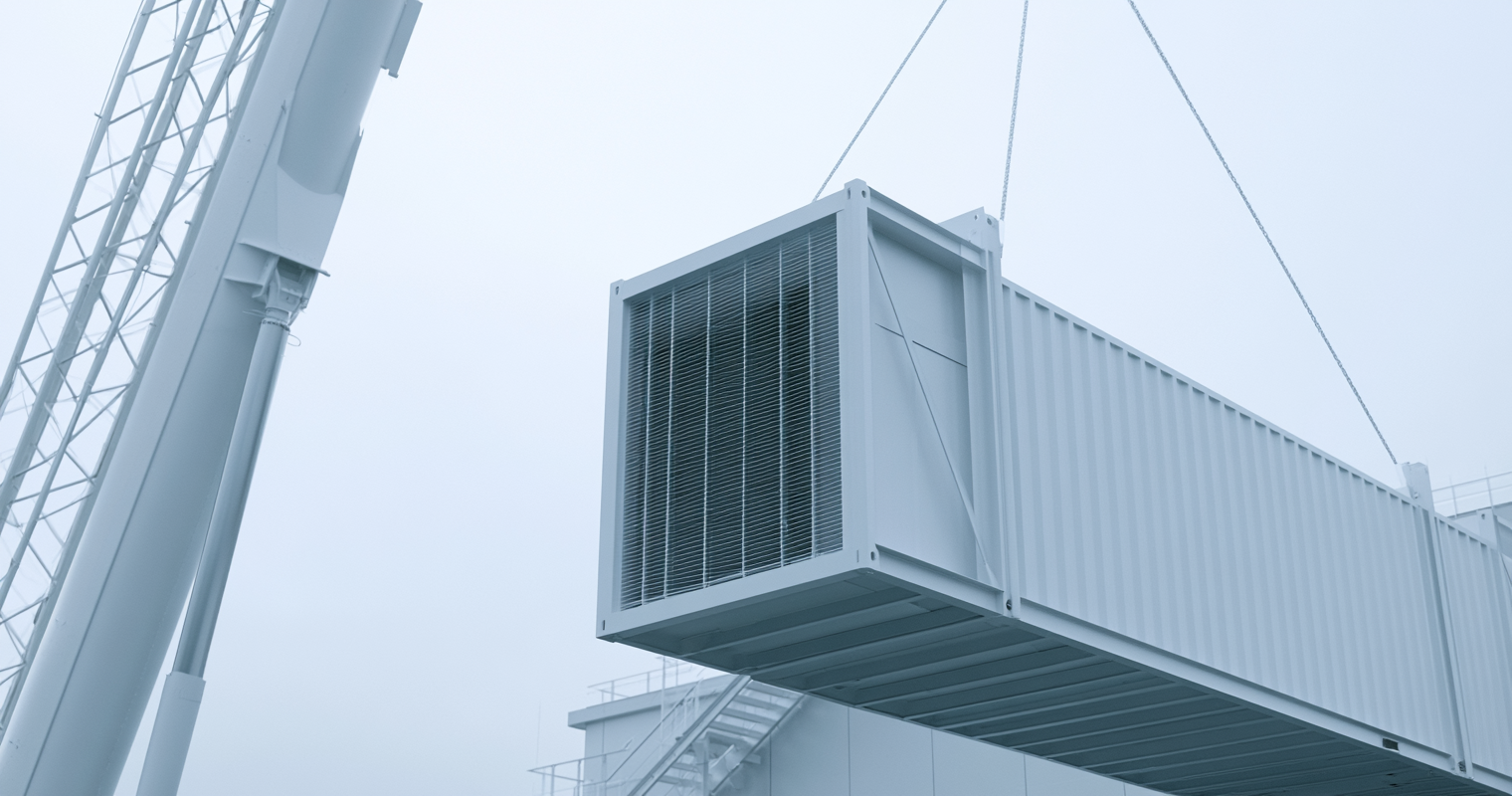
Traditional data center construction can take 18 to 24 months. Infinite Compute’s modular Rowtie systems are designed for 8 to 12 week deployment cycles per module, with factory-built infrastructure shipped to the site. That approach compresses the physical deployment timeline by moving complex work into a controlled manufacturing environment and reducing on-site coordination.
The speed advantage comes from integration, not shortcuts. Modular deployment still depends on secured power, site control, engineering discipline, and operational readiness. The difference is that these elements are planned as one system instead of being assembled through a chain of external dependencies.
For an enterprise buyer, this can change the planning conversation. Direct hardware procurement may appear to offer control, but that control can disappear if the facility path is uncertain. A turnkey AI data center solution backed by owned power and modular deployment gives infrastructure leaders a clearer line between commitment and capacity.
AI infrastructure decisions increasingly include data residency and jurisdictional requirements. For Canadian enterprises, public sector organizations, financial institutions, healthcare companies, and multinationals operating under regional governance rules, location is not incidental.
Sovereign AI depends on more than a policy statement. It depends on where infrastructure is built, who operates it, which legal regime applies, and how data movement is controlled. Infinite Compute's Canadian footprint gives enterprises access to domestic infrastructure backed by renewable energy and stable jurisdictions. Its US presence adds geographic flexibility for North American deployment strategies.
Compliance frameworks also need to sit inside the operating model. SOC 2 Type II matters because enterprise AI workloads often touch sensitive data, regulated workflows, and audit requirements. The facility, compute, network, and management layers have to support those obligations together.
This is another reason hardware alone falls short of turnkey. A compliant cluster is not created by compliant components in isolation. Governance depends on the environment around the cluster and the operational controls applied to it.
The enterprise choice is no longer simply whether to buy GPUs or rent capacity. The real decision is which operating model gives the AI roadmap the best chance of reaching production at scale.
Direct hardware ownership can make sense for organizations with secured power, AI-ready facilities, liquid cooling expertise, infrastructure operators, supply chain leverage, and the time to integrate it all. Few enterprises have all of those conditions in place. Many discover the gap only after capital has been committed.
A true turnkey AI cloud gives the buyer a different path. Power, facility, compute, and management are delivered as one accountable system. Vertically integrated AI infrastructure makes that possible because the operator controls the dependencies that determine whether capacity can be deployed, expanded, and run reliably. This same philosophy of building for the long term, not just the next hardware cycle, is explored further in Purpose-Built and Built to Last.
Infinite Compute was built for that model. Owned power. Owned facilities. Dedicated compute. Managed operations. Bare metal AI orchestration connected to the physical infrastructure beneath it.
For enterprise buyers, the test is direct: if a provider cannot control the power, the facility, the compute, and the management layer, the turnkey promise is incomplete. The companies that treat AI infrastructure as an integrated industrial system will move faster, plan with more confidence, and avoid turning hardware purchases into stranded capacity. Talk to our team about what a true turnkey deployment looks like for your AI roadmap.
New
New
New

.svg)


