Confidential AI Infrastructure: GPU Attestation, Hardware Trust, and the Future of Regulated Workloads
Read More
09 Oct 2026

Enterprise AI roadmaps are now constrained by power, cooling, hardware access, data residency, and operational capacity. Model selection still matters, but infrastructure has become the gating factor between pilots and production. That shift has exposed a strategic gap in the way many enterprises evaluate AI compute.
For years, the choice appeared simple. Build dedicated AI infrastructure internally or rent capacity from a large cloud platform. Both paths can work. Both can fail. At production scale, the decision becomes less about preference and more about control, timing, risk, and operational burden.
A third model is now emerging for enterprises that need durable AI capacity without taking on the full complexity of owning and operating the stack. The managed AI infrastructure partner model gives enterprise AI leaders dedicated capacity, operational accountability, and jurisdictional control through a long-term infrastructure relationship. For the right organization, it offers a clearer path between capital-heavy ownership and shared cloud dependency.
The build option appeals to enterprise leaders who want control. Dedicated AI infrastructure can support predictable capacity planning, tighter security posture, data residency requirements, and deeper integration with internal platforms. For regulated industries, those advantages are material. Financial services, healthcare, government-adjacent organizations, and data-intensive enterprises often cannot treat infrastructure location as an afterthought.
The challenge is execution. AI infrastructure has become a specialized procurement exercise, far removed from standard data center sourcing. Modern GPU clusters require high-density power, advanced cooling, specialized networking, hardened physical security, and experienced operations. Legacy facilities built for 10 to 20 kW per rack struggle to support AI-optimized environments where racks can exceed 130 kW. Power distribution, thermal design, and facility layout determine whether the hardware can perform reliably.

Hardware access adds another constraint. Direct procurement for advanced GPU systems can involve waitlists that stretch up to 12 months. Even after hardware arrives, the enterprise must install, validate, operate, secure, monitor, and refresh it. Internal teams that were built to run business applications or cloud platforms are suddenly responsible for power, cooling, cluster networking, firmware lifecycle management, utilization planning, and failure response.
The rent option reduces that burden. Cloud capacity gives teams a way to move quickly, test models, and avoid facility commitments. That flexibility has real value, especially during exploration and early product validation. Many enterprise AI programs should begin there, because the organization may not yet know which workloads will persist or how demand will behave.
Production changes the calculation. Shared cloud environments can introduce unpredictable capacity access, data movement complexity, jurisdictional concerns, and budget volatility. As workloads move from experiments to business-critical systems, enterprises need clearer guarantees around where data sits, how infrastructure is isolated, and whether capacity will exist when the roadmap requires it.
Enterprise AI compute strategy has matured past that binary. The better question is which parts of the infrastructure stack the enterprise must control, and which parts a specialist should operate.
The infrastructure gap is already visible. According to verified industry data, 81% of enterprise AI projects stall because of infrastructure gaps rather than model quality. That number reflects what AI leaders now see inside their own organizations. The model may work. The data may be ready. The deployment path still breaks under physical and operational constraints.
AI workloads place different demands on infrastructure than traditional enterprise systems. Training and fine-tuning require concentrated compute, high-speed interconnect, fast storage, and careful scheduling. Inference creates sustained production demand, with different patterns around latency, availability, throughput, and data proximity. Retrieval-augmented systems add storage and networking considerations. Agentic workflows increase concurrency and orchestration requirements.
These requirements do not fit neatly into legacy hosting models. North American primary data center markets reached a record-low 1.4% vacancy, while wholesale colocation asking rates rose to about $196 per kW per month in 2025, up 6.6% year over year. Scarcity extends beyond GPUs. Suitable power and high-density facility capacity are now strategic resources.
This matters because enterprise AI is becoming a multi-year capability rather than a series of isolated experiments. Once AI systems connect to customer operations, underwriting decisions, clinical workflows, fraud detection, supply chains, engineering design, or internal knowledge platforms, infrastructure becomes part of the operating model. Capacity shortfalls become roadmap delays. Data movement becomes compliance exposure. Underutilized hardware becomes stranded capital. Operational incidents become business risk.
The right infrastructure strategy must therefore account for more than compute volume. It must address location, resilience, utilization, governance, security, hardware lifecycle, and the ability to expand capacity as the AI roadmap matures.
A managed AI infrastructure partner gives the enterprise a dedicated environment without requiring the enterprise to build and operate the entire stack. The model is built around a scoped deployment, a managed operating relationship, and infrastructure capacity aligned to production workloads.
The managed partner model differs from basic hosting or generic GPU access. The partner is responsible for the underlying physical and operational layers that make AI systems viable at scale. That includes power planning, facility design, cluster deployment, networking, monitoring, maintenance, capacity planning, compliance support, and hardware lifecycle management. The enterprise retains strategic control over workloads, data, models, security requirements, and integration priorities.
For a CTO or VP of Engineering, the value lies in reducing infrastructure uncertainty while preserving architectural intent. The organization can design around dedicated AI infrastructure, predictable capacity, and jurisdictional requirements, while the partner handles the parts of the stack that require specialized physical infrastructure expertise.
For a Head of AI, the model supports a more credible production roadmap. Teams can plan around known capacity instead of hoping shared capacity remains available. They can align infrastructure with model training, fine-tuning, inference, and data governance needs. They can also avoid forcing AI platform teams to become data center operators.
For procurement teams, the model creates a clearer commercial and operational structure than a fragmented mix of hardware purchases, facility contracts, cloud commitments, network agreements, and support vendors. The enterprise buys an infrastructure outcome through a managed relationship, rather than assembling every component separately and carrying the integration risk internally.
The strongest use case for managed GPU hosting enterprise deployments is control. Enterprises adopting this model usually need more than flexible compute access. They need dedicated capacity, clear residency boundaries, security alignment, and operational accountability.
Control begins with infrastructure allocation. Dedicated clusters allow the enterprise to separate critical AI workloads from shared capacity pools and plan usage around business priorities. When clusters are designed for AI from the start, the environment can support high-density racks, liquid cooling, and the networking required for modern accelerated computing.
Control also extends to data residency. For Canadian enterprises and multinationals operating under domestic requirements, infrastructure location can be a procurement requirement. Sensitive data, model weights, and inference inputs may need to remain inside Canadian borders. A managed partner with Canadian-domiciled infrastructure can support that requirement contractually and architecturally.
Operational overhead is where the model earns its place. Owning hardware is the starting point. Operating it as a production platform requires people, processes, and physical infrastructure expertise. Someone must keep clusters healthy, manage failures, coordinate capacity, support upgrades, maintain security posture, and ensure the environment remains aligned with workload demands. The managed partner absorbs that operational load while giving the enterprise the benefits of a dedicated infrastructure footprint.
A company with a large internal infrastructure team, owned facilities, secured power, and a stable multi-year workload may choose to build. A team still exploring use cases may prefer flexible cloud capacity. The managed partner model becomes compelling when AI is important enough to require dedicated infrastructure, while the organization prefers to focus on AI outcomes rather than facility operations.
Infinite Compute is built for this middle ground. The company operates as a vertically integrated AI infrastructure partner for enterprises that need to deploy AI at scale without building or operating the infrastructure themselves.
The model starts with control over the physical stack. Infinite Compute owns power assets, facilities, and compute capacity across North America. Its committed power pipeline exceeds 2.5 GW across North America. That matters because power availability has become one of the defining constraints in AI infrastructure. Enterprises cannot run long-term AI programs on assumptions about future capacity.
The Canadian footprint is especially relevant for sovereignty-driven workloads, anchored in renewable energy sourcing. For enterprises with data residency, sustainability, and procurement requirements, those attributes are part of the infrastructure decision itself.
Infinite Compute’s facilities are designed for AI density rather than retrofitted around it. The platform supports AI-optimized deployments above 130 kW per rack, with an efficiency target below 1.2 PUE. Modular Rowtie deployment can compress timelines to 8 to 12 weeks compared with 18 to 24 months for traditional data center construction. That deployment speed changes planning conversations for enterprises trying to move from approved AI strategy to production infrastructure.
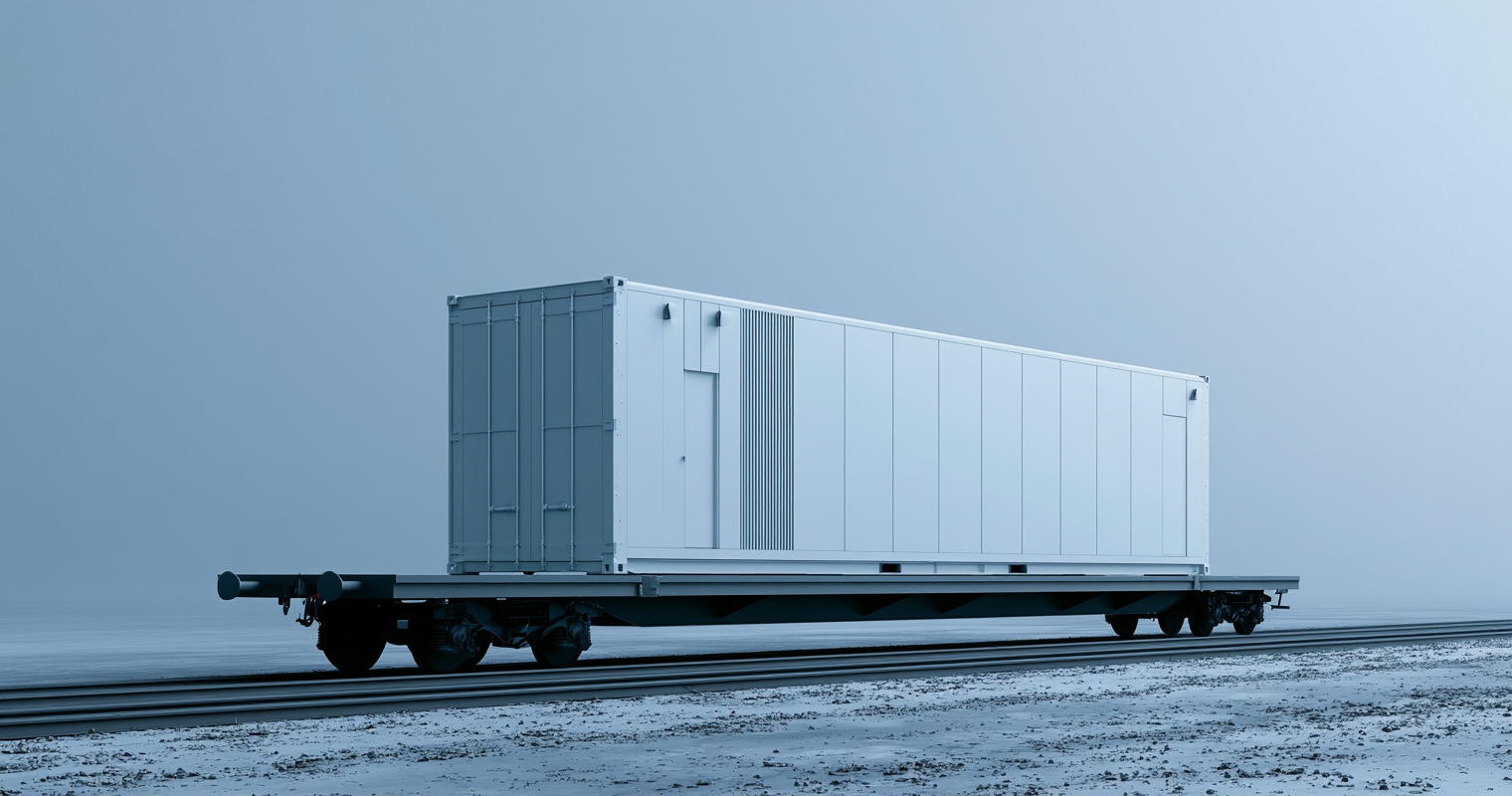
The compute layer is built for enterprise-scale workloads. Infinite Compute supports bare metal clusters from 8 to 10,000+ GPUs, connected with InfiniBand NDR. As an NVIDIA Partner Network certified provider, Infinite Compute has access to priority hardware allocation. The managed service layer then carries the operational burden, from deployment planning through lifecycle management, so enterprise teams can focus on AI systems rather than facility operations. This model sits at the center of Infinite Compute's broader AI Cloud Platform.
Compliance posture also matters at this stage of the market. Infinite Compute supports SOC 2 Type II requirements, giving regulated buyers a stronger foundation for procurement and governance review. For enterprises moving sensitive workloads into production, compliance cannot be patched onto infrastructure after the fact.
Enterprise AI leaders now have a third option beyond building everything themselves or relying entirely on rented capacity. That framing belongs to an earlier stage of the market, when AI workloads were smaller, less regulated, and less central to business operations.
The more durable question is how much control the enterprise needs, how much operational burden it is prepared to carry, and how quickly the infrastructure must be ready. Build remains valid for organizations with the capital, facilities, power, and internal operating depth to support it. Cloud capacity remains useful where flexibility and experimentation dominate. The managed AI infrastructure partner model fits the enterprise that has moved past experimentation and now needs dedicated, governed, production-grade AI capacity without assuming the full burden of infrastructure ownership.
That choice will shape which AI roadmaps reach production and which remain trapped behind constraints the model team cannot solve. For a closer look at what enterprises should expect when they choose managed compute, see The Enterprise Guide to Managed AI Compute. For enterprises specifically evaluating a move off an existing hyperscaler, see Migrating AI Workloads from Hyperscalers to Dedicated Infrastructure. Enterprises that treat AI infrastructure as a strategic operating layer will make better decisions than those that treat it as a procurement line item. The winners will secure power, capacity, governance, and operational accountability before those constraints define the limits of the business. Talk to our team about whether the managed partner model is right for your AI roadmap.
New
New
New

.svg)


